

Most "wide" labels on a western saddle are a flat-out lie. You've likely spent a fortune on gear that promised a perfect fit, yet you're still dealing with a saddle that rolls the moment you put a foot in the stirrup. Finding a genuine western saddle for wide horse isn't about chasing a bigger number on a spec sheet. It's about understanding the raw mechanics of how a tree actually sits on a broad back without the marketing fluff.
We know the frustration. You're tired of seeing white hairs on the withers and feeling that heavy, clunky shift during tight turns. It's a rubbish way to ride and it's doing your horse no favours. This guide is here to stop the pinching and the guesswork for good. You'll learn why bar angles matter more than gullet width and how to pick gear that stands up to the brutal Australian climate. We're stripping back the industry nonsense to get your horse moving freely again.
Key Takeaways
- Stop over-cinching to fix a rolling saddle. Learn why the tree shape, not the girth, is the real reason your gear won't stay centred on a flat-backed horse.
- Discover why a western saddle for wide horse needs more than just a wide gullet. Matching the bar angle to your horse's ribs is the secret to stopping painful pinching and dry spots.
- Compare tree types from Full QH Bars to Draft trees. Get the facts on which build actually suits a muscular stock horse versus a truly massive, wide-shouldered frame.
- Master the DIY fit test using the "No-Pad" method. Learn how to use a simple hand-slide check to ensure even pressure and total freedom for the shoulder blades.
- Prioritise rugged durability over polished aesthetics. Choose gear designed for the grit of Australian riding conditions that puts horse comfort and tree integrity first.
The Struggle is Real: Why Standard Western Saddles Fail Wide Horses
Flat-backed horses are a nightmare for standard off-the-shelf gear. We call them "table-tops" for a reason. These horses, often mutton-withered with shoulders like a brick outhouse, don't have the typical "A" frame that most manufacturers build for. When you try to slap a standard rig on a broad back, the physics just don't work. It's a recipe for gear failure and a very cranky horse.
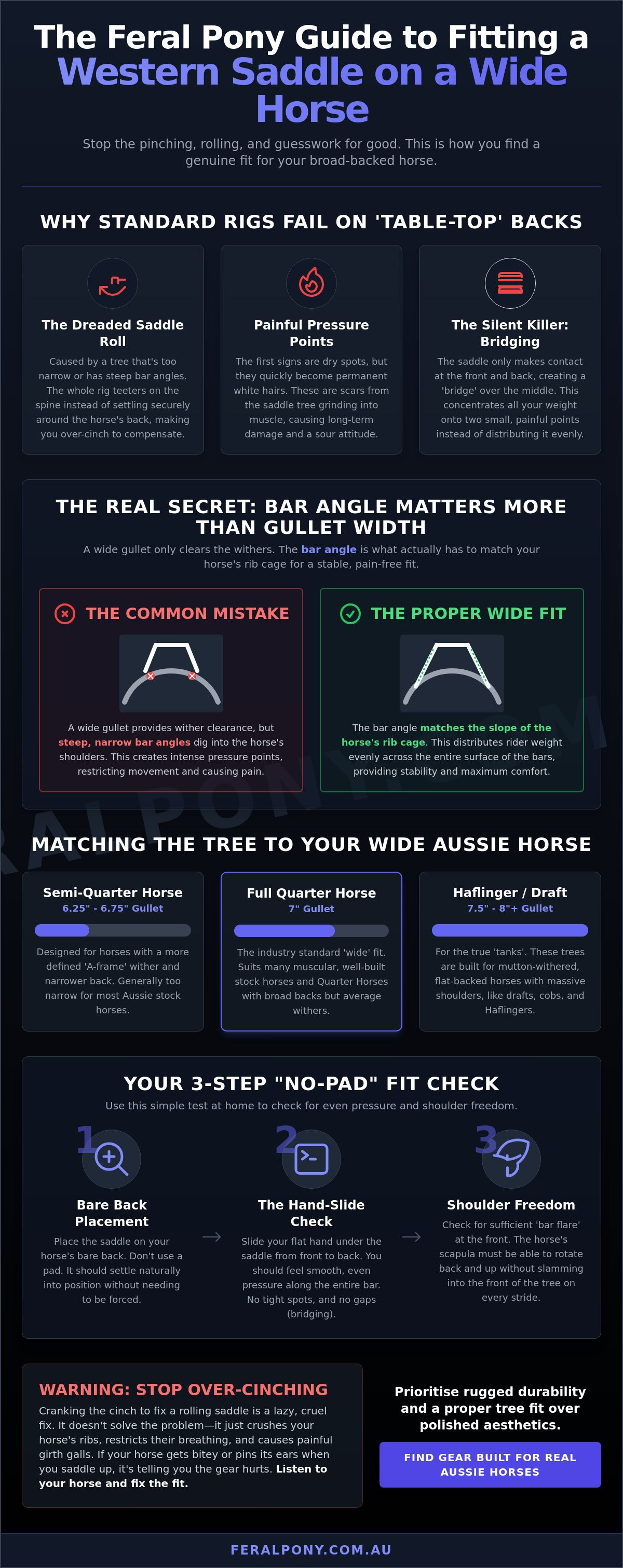
The most common complaint is the dreaded saddle roll. Most riders think a rolling saddle means they haven't tightened the cinch enough. That's rubbish. The roll happens because the Western saddle tree is too narrow or the bars are too steep. It sits on top of the horse rather than around it. A genuine western saddle for wide horse needs to distribute weight across the entire bar surface. If it doesn't, the whole thing just teeters on the spine like a seesaw. You'll see the evidence in dry spots or, eventually, white hairs. These are scars from pressure points where the saddle has been grinding into the muscle.
Bridging is the other silent killer. This happens when the saddle only makes contact at the front and the back, leaving a gap in the middle. It concentrates all your weight onto two small points. On a wide-backed horse, this often happens because the tree doesn't have enough "rock" or curvature to follow the horse's topline. It's uncomfortable, it's inefficient, and it'll ruin your horse's desire to work.
Common Signs Your Current Saddle is Too Narrow
If your saddle has the "perched" look, sitting high and mighty above the withers with a massive gap underneath, it's too narrow. You'll also notice the horse's movement is restricted. They'll take shorter, choppier steps because the tree is pinching the shoulders. Another dead giveaway is the "popping" cinch. When you tighten up, the back of the saddle lifts off the horse's loin. That's the tree telling you it doesn't fit the frame.
The Danger of Over-Cinching to Compensate for Poor Fit
Cranking the cinch to stop a western saddle for wide horse from rolling is a bush-league move. It's lazy and it's cruel. All you're doing is crushing the horse's ribs and restricting their breathing. This leads to painful girth galls and pressure sores that take weeks to heal. Worse than the physical damage is the psychological toll. Your horse will start pinning ears, biting, or dancing away when they see the saddle. They aren't being "naughty." They're telling you that your gear hurts. Stop the squeeze and fix the fit instead.
Gullet Width vs. Bar Angle: The Secret to a Proper Wide Fit
Most riders make the same mistake. They look at a gullet measurement and think that's the end of the story. It isn't. The gullet is just the horizontal space between the forks. It's about wither clearance. But a western saddle for wide horse needs more than just a wide gap at the top. You have to look at the bar angle. This is the vertical slope where the tree actually meets the horse's ribs. If the angle is too steep, the width of the gullet won't save you.
Think of it like a pair of boots. You can have a wide sole, but if the sides are too narrow, your feet are going to ache. A 7-inch gullet might sound wide, but if the bars are set at a steep angle, they will still dig into the shoulders. It’s a common trap. You get the width at the withers but the tree still pinches the life out of the horse further down. You need expert saddle fitting advice to understand that the "twist" and "rock" of the tree are just as vital. The twist is how the angle of the bars changes from front to back, following the rib cage. The rock is the curve along the spine. If these don't match, you're just sitting on a bridge or a seesaw. No amount of padding will fix a tree that doesn't follow the horse's natural lines.
Understanding Western Tree Measurements
The industry likes its labels. Semi-Quarter Horse Bars (SQHB) usually sit around 6.25 to 6.75 inches. Full Quarter Horse Bars (FQHB) are the standard "wide" at 7 inches. But for the real tanks, the Haflinger or Draft trees push out to 7.5 or 8 inches. Bar flare is the outward curve at the front of the saddle tree. This flare is what gives the horse room to move without the tree acting like a wall. Without it, even a wide gullet will feel like a vice.
Why Wide Shoulders Need More Than Just a Wide Gullet
Wide-backed horses often have massive, active shoulders. When they move, the scapula rotates back and up. If your saddle doesn't have a proper shoulder pocket or enough bar flare, that bone is going to slam into the tree every single stride. It's why many wide horses get "short-strided" under a western rig. They're trying to avoid the pain. Your rigging position also plays a role. A 7/8 or full rigging can pull a wide tree down too hard if the angle is off. If you're struggling with a barrel-shaped horse, checking out our rugged western saddles might be the first step to a better ride. A well-designed tree distributes that weight across the bars, letting the shoulder slide through without interference.
Comparing Tree Types for the Australian Wide Horse
The Australian paddock is full of "absolute units." From muscular stock horse crosses to chunky Quarter Horses, these animals don't fit the narrow, high-withered mould. When you're hunting for a western saddle for wide horse, the label on the tree matters more than the tooling on the leather. Full Quarter Horse Bars (FQHB) are the industry standard for a wide build, usually sporting a 7-inch gullet and a flatter bar angle. Most well-muscled stock horses will find their match here. But for the truly massive frames, you have to look further.
Draft and Draft-Cross trees are built for the heavy hitters. These trees push the gullet out to 8 inches and flatten the bars even more to accommodate shoulders that look like they belong on a bulldozer. Don't overlook gaited trees either. While they're designed for movement, their higher gullets and extreme bar flare can be a godsend for a non-gaited horse with a massive shoulder rotation. On the flip side, be wary of flex trees. While they promise a custom fit, they can "bottom out" on a wide, heavy horse. This creates nasty pressure points right where you don't want them. For a deeper dive into these basics, check out this Western Saddle Fit 101 guide which breaks down why tree selection is the foundation of a good ride.
Leather vs. Synthetic Trees for Wide Builds
Weight is a double-edged sword. A lighter synthetic saddle is easier to hoist onto a 16-hand tank, but it lacks the "give" of a quality leather build. Leather moulds to the horse over time. It develops a memory of the horse's shape. Cheap synthetic gear often lacks this resilience and can curl up like a prawn in the brutal Australian sun. If you want gear that lasts through droughts and floods, stick with leather. It’s heavier, but it provides a more stable base that won't warp when the temperature hits forty degrees.
The Short-Backed Wide Horse Dilemma
Wide horses often come with short backs. It's a tricky combo. If your saddle is too long, the bars will extend past the 18th rib and dig into the horse's loin. This causes bucking, sourness, and kidney pain. Square skirts are the enemy here. They look traditional, but they'll hit the horse's hip with every stride. Round skirts are the solution. They provide the same weight distribution without the unnecessary length. Keep it compact. Your horse's spine will thank you for it.
The DIY Fit Test: How to Check Your Saddle at Home
Stop trusting the bloke at the tack shop and start trusting your own hands. If you want to know if a western saddle for wide horse actually fits, you have to strip it back. Ditch the pad. Throw the saddle directly onto the horse's back. This is the "No-Pad" test. It’s the only way to see where the tree bars are actually making contact. If you see daylight where there should be leather, or if the saddle is perched like a bird on a fence, you've got a problem. No amount of fancy tooling can hide a tree that doesn't match the horse's frame.
Next, use the hand-slide. Run your hand under the front of the saddle, right where the bars sit against the shoulder. It should feel firm but even. If your fingers get crushed, the tree is too narrow. If it’s loose and rattling, it’s too wide. Don't get hung up on the "three fingers" wither rule. Many wide horses are mutton-withered; they don't have three fingers of clearance to give. You just need enough room so the spine never touches the gullet. After a ride, look at the sweat. A dry spot isn't always a good thing. Often, it's a high-pressure zone where the saddle has squeezed the sweat glands shut. You want an even, damp pattern across the whole back without any bone-dry patches under the bars.
Step-by-Step Hand-Slide Procedure
Start with the horse standing square on level ground. Slide your hand under the shoulder and have a mate pick up the horse's front leg and pull it forward. This mimics the scapula's movement. If the tree pinches your hand as the leg moves, it’ll pinch the horse every time they take a step. Move your hand further back to the middle of the bars. If you feel a gap where your hand can move freely, that's bridging. Finally, check the loin. There should be no pressure directly on the spine or the very edge of the ribs. The bars should distribute weight across the muscle, not the bone.
The Myth of the 'Thick Pad' Fix
We see this rubbish on social media all the time. Someone says their saddle is rolling or pinching, and a "keyboard expert" tells them to buy a thicker pad. That is absolute nonsense. Adding a thick pad to a narrow saddle is like wearing two pairs of thick wool socks with boots that are already too tight. It just increases the pressure and makes the roll worse. A saddle that is too wide can be padded up, but a saddle that is too narrow will always pinch. If your tree is the wrong shape, no amount of felt or wool will save your horse from the bite of a bad fit. If you've done the test and found your tree is failing, it's time to invest in Western saddles built for real builds that respect the horse's anatomy.
Feral Pony Solutions: Rugged Gear for Real Horse Shapes
We don't do "pretty" if it doesn't perform. If a rig looks like a million bucks but leaves your horse sour and short-strided, it belongs in the bin, not on a broad back. Our focus is on the grit. We build gear for the dust, the sweat, and the reality of Australian riding. Finding a western saddle for wide horse shouldn't feel like a gamble. You need a tool that respects the massive shoulders and flat backs of our local stock. Our approach is simple: durability first, ego second.
A properly fitted tree is the foundation, but the rest of your kit needs to pull its weight too. We see too many wide horses restricted by flimsy gear that can't handle their power. From our custom rope halters to our heavy-duty bridles, every piece is designed to complement a wide-fit setup. It’s about creating a system that stays centred and stable, even when you're working hard in a paddock that hasn't seen rain in six months. We understand the messier side of horse ownership because we live it every day. When you buy a western saddle for wide horse from us, you're getting gear that was tested in the scrub, not just a showroom.
Stabilise the Ride with Feral Pony Breastplates
Wide, barrel-chested horses are notorious for making saddles shift. Even with a perfect tree, a bit of extra stability goes a long way. But most breastplates are built for narrow frames, often cutting across the windpipe or digging into the shoulder. Our Western breastplates are different. We use heavy-duty leather and hardware that won't quit when the going gets tough. They’re designed to sit in the right spot, allowing the scapula to rotate freely while keeping your rig from sliding back on a steep climb. It’s gear that matches your gritty aesthetic without sacrificing the horse’s comfort.
Ready to Get Properly Sorted?
We aren't some faceless corporate entity. Our roots are deep in the reality of Australian horsemanship. We grew up around the "big" horse reality. We know what it’s like to try and fit a saddle to a horse that looks more like a tank than a Thoroughbred. If you’re tired of the roll, the pinch, and the white hairs, it’s time to stop settling for gear that wasn't made for your horse's "feral" shape. We’re here to help you get sorted with honesty and utility. No fluff. Just gear that works.
Check out our range of rugged Western gear here
Ditch the Roll and Get Back to Riding
Stop making excuses for gear that doesn't fit. Your horse deserves better than a tree that pinches or a cinch that has to be cranked until they can't breathe. Finding a western saddle for wide horse is about looking past the standard labels and checking the actual bar flare and rock. If you've done the no-pad test and seen the gaps, don't ignore them. A thick pad is just a band-aid for a bad foundation. It won't fix a tree that was never meant for a broad back.
We’re Australian owned and operated. We build gear for "real horse life" durability because we know how tough the conditions get out in the scrub. We specialise in custom rope work and leather gear that actually stands up to the work. You don't need pretty or polished gear. You need gear that stays centred and keeps your horse moving freely without the shift. Get your fit sorted today and feel the difference in your horse's stride. You've got the knowledge now. Go use it.
Shop our range of rugged Western saddles and gear
Frequently Asked Questions
What is the best gullet width for a wide horse?
Most wide horses need a gullet width of at least 7 inches, which is the standard for Full Quarter Horse Bars. For truly massive Draft-cross types, you'll likely need to push out to a 7.5-inch or 8-inch gullet. Don't just chase a number. The width only matters if the bar angle matches the rib cage. If those bars are too steep, even an 8-inch gullet will pinch the shoulders.
Can I use a wide Western saddle on a horse with high withers?
No, putting a wide tree on a high-withered horse is a recipe for disaster. It lacks the vertical clearance needed and will likely bottom out directly on the spine. This causes painful pressure points and long-term nerve damage. High withers need a narrower gullet with more height. A western saddle for wide horse is specifically built for flat, broad backs that lack a prominent wither.
Will a Full QH Bar saddle fit my Draft cross?
Probably not, as most Draft crosses have shoulders that exceed the 7-inch standard of Full QH Bars. You'll likely need a dedicated Draft tree with an 8-inch gullet and flatter bars to accommodate that bone and muscle. While FQHB fits most muscular stock horses, the sheer width of a Draft cross requires a specialized tree to prevent the rig from acting like a vice.
How do I stop my Western saddle from rolling on my round horse?
Stop cranking the cinch and check your tree fit first. Rolling happens when the tree sits on top of the horse instead of around it. If the bars don't match the back's shape, the rig will never stay centred. Once the fit is right, a heavy-duty breastplate can help stabilise things during mounting or tight turns without the need to crush the horse's ribs.
Is a flex tree better for a wide-backed horse?
Flex trees aren't a magic fix and can actually cause issues for heavy-set horses. They can "spread" too far under a rider's weight on a wide back, which often leads to pressure on the spine. For a horse with a lot of muscle, a solid wood or high-quality leather-covered tree provides a more stable, predictable base that won't warp or collapse during a long day in the paddock.
How can I tell if my saddle is pinching my horse's shoulders?
Watch your horse's stride for short, choppier steps. If they aren't reaching out properly, the tree is likely blocking the scapula. Use the hand-slide test while the horse is standing square. If you can't easily slide your fingers under the front of the bars, the tree is too narrow. Pinching is a fast way to make a horse sour and unwilling to work.
Should I use a different cinch for a wide horse?
A wider roper cinch or a contoured design is often better for rounder frames. It provides more surface area, which helps keep the western saddle for wide horse stable without needing to over-tighten. Use quality materials like mohair or felt that won't gall the horse. A wider cinch helps with stability, but it won't compensate for a tree that is the wrong shape for the horse.
Does a wider saddle need a different type of saddle pad?
Avoid thick, bulky pads on a wide horse. Adding more material just makes a wide horse even wider and increases the chance of the saddle rolling like a log. A high-quality 3/4 inch felt pad is usually enough. It provides necessary shock absorption without creating a "perched" feeling. Keep it simple and let a well-fitted tree do the actual job of distributing your weight.