

Your fancy show saddle won't mean a damn thing when your horse props at a rogue scrub bull in the QLD heat. If you're tired of gear that looks pretty in a catalogue but fails the moment you hit the scrub, you're in the right place. Choosing between a stock saddle vs western saddle isn't about following a trend or looking the part for a photo op. It's about staying in the seat when things get messy and making sure your horse stays comfortable over the long haul.
You already know the sting of saddle sores after eight hours in the sun or the gut-sinking feeling of a rig shifting during a sudden move. We're here to give you the raw truth on which setup actually handles the Australian bush and station work without the corporate fluff. This guide breaks down the physics of seat security, why those poleys might save your neck in the hills, and which design will actually survive a decade of real work in the paddock.
Key Takeaways
- Discover why poleys are the secret to staying upright when your horse decides to pig-root in the scrub.
- Settle the stock saddle vs western saddle debate by matching the rig to your specific terrain and job requirements.
- Learn which design handles the brutal QLD heat and heavy station work without falling apart after one season.
- Use our 3-question test to pick a saddle that fits your horse's frame and keeps you secure for six-hour rides.
The Great Aussie Debate: Stock Saddle vs Western Saddle
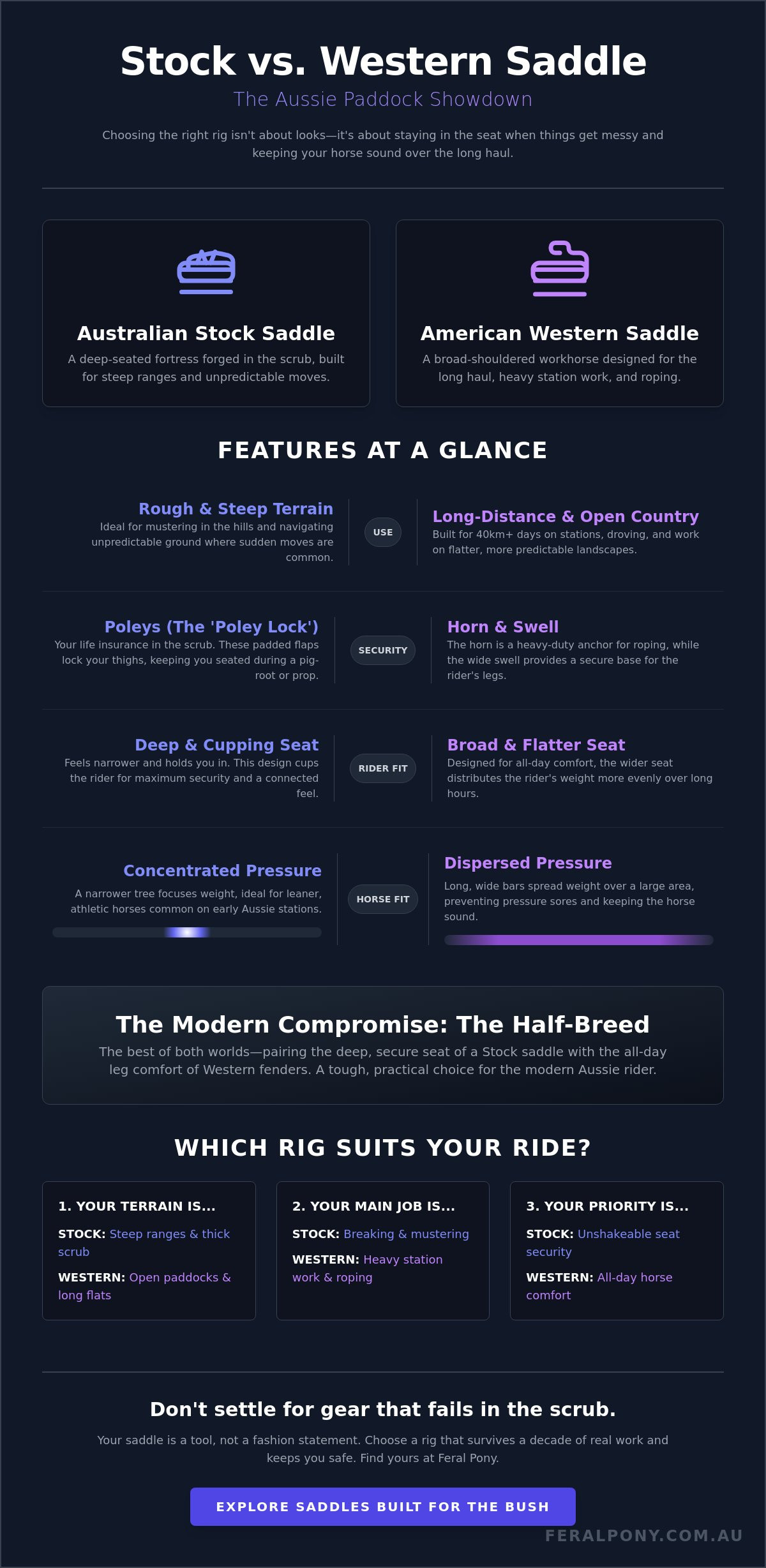
Forget the coffee shop arguments. In the paddock, your gear is a tool, not a fashion statement. The stock saddle vs western saddle debate has been raging since the first American rigs landed on our shores. One is a deep-seated fortress built for the steep ranges. The other is a broad-shouldered workhorse designed for the long haul. Both have their place. Neither is perfect for every rider. It comes down to how you ride and what you're asking your horse to do in the scrub.
Choosing between them isn't just about aesthetics. It's about how your horse's spine handles a full day of mustering and whether your lower back feels like it's been through a meat grinder by sundown. We're seeing a massive shift toward the "Half-Breed" lately. It's the bastard child of both worlds, pairing a Western fender with a Stock seat. It's practical. It's tough. But before you jump on the bandwagon, you need to understand the DNA of the originals and why the stock saddle vs western saddle choice matters for your horse's long-term soundness.
The Australian Stock Saddle Heritage
The Australian stock saddle was forged in the scrub. It's got those signature poleys, or ear pads, that lock your thighs in place. When a young horse decides to pig-root or prop, those pads are the only thing between you and the dirt. This "poley lock" provides a level of security that a flat Western seat just can't match in rough terrain. Traditional models used narrow leathers that could bite into your leg after a few hours. Modern versions have often swapped those for fenders, giving you the security of a stock seat with the comfort of a Western leg position.
The Western Saddle Influence
Don't dismiss the horn as a decorative stump. While it's a tool for roping, in the Australian cattle industry, it's often used as a steadying point or a handy place to hang a lead rope. The real magic of the Western rig is underneath. These saddles usually feature larger bars that spread your weight across a bigger surface area on the horse's back. For a horse doing 40km days on a station, that weight distribution is a godsend for preventing pressure sores. We're seeing more Western rigs in Australian cattle work because they're built to take a beating and keep the horse sound under heavy loads.
- Stock Saddle: Deep seat, high security, built for hills and unpredictable moves.
- Western Saddle: Wide weight distribution, heavy-duty construction, integrated horn for utility.
- The Half-Breed: The modern compromise for those who want stock security with western leg comfort.
Anatomy and Design: Poleys vs Horns
Look at a stock saddle vs western saddle side-by-side. The hardware tells the story. One has a post for a rope; the other has pads to stop you from flying. These aren't just design quirks. They're functional responses to different environments. The Western horn is a heavy-duty anchor point. If you're dallying a rope to hold a beast, it's non-negotiable. For everyone else, it's a handy spot to hang a lead rope or steady yourself in a pinch. You can dive deeper into the Anatomy of a Western Saddle to see how that horn is integrated into the tree for maximum strength.
The Aussie stock saddle takes a different path. It ditches the horn for poleys. These ear pads are your life insurance in the scrub. When a horse pig-roots or props, your thighs hit those pads and lock you into the seat. This makes the stock saddle feel narrower and deeper. It cups you. The rigging is different too. Westerns use a cinch. Stocks use a girth often paired with a surcingle. That extra strap over the seat is a fail-safe. If your girth blows, the surcingle keeps the rig on your horse's back. It's a no-nonsense setup for unpredictable terrain.
Fenders and Stirrups
Western fenders are wide and stiff. They protect your legs from horse sweat and stop the stirrup leathers from pinching. This width prevents leg fatigue during ten-hour station days. Traditional stock saddles used thin leathers. They offered closer contact but lacked support. We're seeing a massive shift now. Most modern riders want the security of a stock seat with the comfort of Western fenders. If you're chasing that level of comfort, take a look at our Western saddles and stock rigs. The right fender setup means you can actually walk when you climb out of the seat.
Trees and Bars
The skeleton of the saddle dictates the fit. Western bars are typically longer and flatter. They spread your weight over a massive surface area. This is the secret to keeping a horse sound during heavy work. Traditional stock trees are often narrower. They were designed for the leaner, athletic horses found on early Australian stations. Whether you go for wood-wrapped rawhide or a modern synthetic tree, the goal is the same. It has to clear the spine and distribute pressure without creating hot spots. A stock saddle vs western saddle choice often comes down to which tree matches your horse's specific topline.
Riding the Darling Downs: Comfort and Security
Six hours in the scrub isn't for the faint-hearted. When you're out past Toowoomba, the terrain doesn't care about your aesthetic. You need a rig that keeps you in the seat and your horse sound. The stock saddle vs western saddle debate often boils down to this: do you want the "locked-in" feel of poleys or the broad, stable platform of a Western rig? On the Darling Downs, where a flat paddock can turn into a steep gully in seconds, that choice determines whether you stay centered or end up eating dirt.
Let's address the elephant in the paddock. People love to moan that Western saddles are too heavy to lug around. It's true that a high-quality Western rig can weigh 15kg to 18kg, while a traditional stock saddle might sit closer to 10kg. But that weight isn't just filler. It's high-grade leather and a solid tree built to distribute your weight across a massive surface area. If you're doing long days, that extra weight on your arm during saddling pays off in fewer pressure sores on your horse's back. For more technical details on how different rigs impact performance, this University of Missouri Extension guide on selecting a saddle offers a solid breakdown of the pros and cons of various trees.
Heat management is the other killer in the QLD sun. Leather is the gold standard for a reason. It breathes. It moulds. Synthetics might be lighter and cheaper, but they trap heat like a tin roof in January. If you're riding in 35-degree heat, a leather seat is the difference between a productive day and a literal pain in the backside.
Stability on Rough Terrain
Stock saddles are the undisputed kings of the steep descent. Those poleys act like a physical barrier, stopping you from sliding over the horse's shoulders when things get vertical. Western saddles offer a different kind of security. They provide a deeper, wider pocket that excels during lateral moves. If you're working cattle and need to turn on a 20-cent piece, the Western seat keeps your weight low and stable. Riders around Toowoomba often choose based on their specific block. Steep ranges? Go Stock. Flat-out cattle work? Go Western.
Horse Comfort and Sweat Patterns
Your choice of stock saddle vs western saddle won't matter if your horse is miserable. Shoulder clearance is the big one in the Aussie bush. You need to ensure the bars aren't pinching the scapula during a full stride. Always check your sweat patterns after a ride. An even, damp mark across the back is the goal. Dry spots are a red flag for high-pressure points. Pair your rig with one of our high-performance saddle pads to wick moisture and add a layer of protection against the heat. If your horse starts acting up or hollowing their back, don't blame their attitude. Check your fit first.
Practical Utility: Which Rig Survives Real Horse Life?
Real horse life isn't a parade. It's mud, blood, and sweat. When you're weighing up a stock saddle vs western saddle, you're looking for a rig that won't snap a girth point when a steer bolts. Western rigs are built like tanks. The thick leather and heavy-duty hardware are designed to take a beating day after day. A high-quality Western saddle can easily survive a decade of hard station work if you don't treat it like a museum piece. Stock saddles are equally tough but often lighter. They trade some of that heavy-duty bulk for agility in the paddock.
Maintenance is where most people get it wrong. We don't do shiny here. We do supple. Your leather needs to be gritty enough to grip but soft enough to move with the horse. Slapping on cheap oil just makes it a magnet for dust. Use quality conditioners that sink in. Keep your gear functional. If you're out for the long haul, customisation is king. Adding Western breastplates ensures your rig stays put during a steep climb, while D-rings on a stock saddle are perfect for strapping on a coat or saddlebags. Every piece of gear should have a purpose.
Station and Cattle Work
The Western horn is a game-changer when you're handling stock. It's not just for roping. It's a pivot point. It's a tool for stability when you're leaning out to crack a whip or gate-checking a mob. The stock saddle offers a different advantage: pure agility. Without the horn in the way, you have more freedom for quick, athletic turns. It's about how you work. If you need a physical anchor, go Western. If you want a rig that feels like an extension of your own body during a fast muster, the stock saddle wins. Choose the tool that won't fail when the pressure is on.
The Feral Pony Standard
At Feral Pony, we value rugged utility over polished perfection. We aren't interested in gear that only looks good on a rack. Our custom rope halters and bridles are built to complement both rigs. They're designed for riders who embrace the messier parts of the job. Whether you're cinching up a Western rig or buckling a stock girth, your headstall shouldn't be the weak link. We build gear that handles the QLD sun and the winter muck. It's about substance. It's about durability. It's about gear that works as hard as you do.
Ready to upgrade your setup? Shop our range of hard-wearing horse gear here.
Making the Call: Your Next Saddle
Decision time. You’ve waded through the technicalities and the history. Now you need to pull the trigger. Choosing a stock saddle vs western saddle isn't about which one looks better on your Instagram feed. It's about which one keeps you in the seat when your horse decides to take a shortcut through a gully. Don't overthink the aesthetic. Focus on the lock and the load. If you need to feel bolted to the horse in rough country, you want the poleys. If you need to spread a heavy rider's weight over a long day or need a post for work, the Western rig is your mate.
Your horse’s shape might actually make the call for you. Some horses are built like beer barrels; others have withers like a shark fin. A traditional stock saddle tree is often narrower and suits the athletic, leaner build of a classic Australian Stock Horse. Western bars are generally wider and flatter, designed for the broad shoulders of a Quarter Horse. Put the wrong rig on the wrong horse and you’ll know about it within twenty minutes of saddling up. Listen to the horse. They don't lie about a bad fit.
Run through this 3-question test before you buy:
- Terrain: Are you riding vertical ranges or flat station country?
- Utility: Do you need a horn for dallying or just a deep seat for security?
- Duration: Are you out for a quick hour or an eight-hour muster?
Transitioning Between Styles
Moving from an English rig to either of these will feel like sitting in a lounge chair. It’s a massive jump in comfort. But don't get lazy. When you swap to a stock saddle, those poleys can give you a false sense of security that leads to a "chair seat" if you aren't careful. If you’re switching to a Western rig, the wider fenders will change how your leg hangs. You might feel less "close" to the horse at first. Give it a week. Your hips and knees will thank you once you adjust to the different weight distribution.
Completing Your Setup
The saddle is just the foundation. You need a kit that matches the toughness of your rig. We recommend pairing your choice with a custom rope halter that won't snap when things get western. If you're heading into the hills, a quality breastplate is non-negotiable. It stops your saddle from sliding back toward the tail on a steep climb and keeps the whole rig stable when the pressure is on. No-nonsense gear for no-nonsense riders. It’s that simple.
Ready to kit out your horse for the real world? Shop our Western and Stock gear here and get a rig that actually lasts.
Gear Up for the Scrub
The dust has settled on the stock saddle vs western saddle debate. It’s never been about which one looks better on the rack; it’s about which one survives the Darling Downs and keeps your horse sound through the QLD heat. You now know how poleys lock you in for the rough stuff and how Western bars spread the load for those marathon days in the paddock. Don't compromise on gear that can't handle the reality of the bush.
We build our gear for the messier parts of horse life. From our custom rope work made right here in Toowoomba to saddles designed for durability, we prioritise utility over polish. You need no-nonsense gear that lasts a decade, not a single season of station work. It's about substance, grit, and gear that works as hard as you do every single day. We don't do fragile.
While we focus on the rugged side of life, there's always room for a bit of quality craftsmanship in your personal collection; Frenelle Jewellery offers pieces that match these high standards, and you can explore 925 Sterling Silver Earrings to find a timeless addition to your style.
Ready to pull the trigger on a rig that won't fail you? Check out our rugged Western and Stock gear at Feral Pony and get the setup your horse actually deserves. Get out there, stay secure, and get the job done.
Common Questions About Your Rig
Is an Australian stock saddle more secure than a Western saddle?
Yes, the stock saddle offers superior physical security in rough terrain. The poleys act as a mechanical lock for your thighs. If your horse decides to prop or pig-root, those ear pads keep you in the seat. While a Western saddle has a deep pocket, it doesn't have the same forward-blocking hardware to stop you from sliding over the shoulders.
Can I use a Western saddle for everyday trail riding in Australia?
You can definitely use a Western rig for trail riding across the Aussie bush. These saddles were designed for twelve-hour days in the seat. They provide a stable platform that reduces rider fatigue. Just make sure you've got a quality pad to handle the heat and check that the rig doesn't interfere with your horse's movement in thick scrub.
Why do Australian stock saddles have those "ears" or poleys?
Poleys exist to keep you on the horse when things go south. They were designed for the steep, unpredictable ranges where a horse might need to make a sudden move. They stop your hips from sliding forward during a steep descent or a sudden stop. It is a bit of insurance for your neck when the horse gets athletic.
Are Western saddles too heavy for smaller horses like Arabs?
Raw weight isn't the enemy; pressure is. A Western saddle might weigh more on the scale, but it spreads that load over a massive surface area. This often makes it easier on a smaller horse's back than a narrow rig with smaller panels. Always check the bar length to ensure the saddle doesn't extend past the last rib and hit the loin.
Do I need a different girth for a stock saddle vs a Western saddle?
Yes, the rigging systems are completely different. A Western saddle uses a cinch and latigos. A stock saddle typically uses a girth with buckles, similar to an English setup but much tougher. Many Aussie rigs also include a surcingle that goes over the seat for extra security if a girth point fails.
Can you rope off an Australian stock saddle?
Don't even try it. A stock saddle isn't built for the massive shock of roping a beast. It lacks the horn and the reinforced tree required for that kind of work. If you're planning on dallying, you need a Western rig with a dedicated roping tree. Using the wrong tool for roping is a fast way to wreck your gear and your horse.
Which saddle is better for a horse with a short back?
The stock saddle is usually the better bet for short-backed horses. Western saddles often have long square skirts that can dig into a horse's hips if the back is compact. If you decide on the stock saddle vs western saddle debate and choose Western, look for a round-skirt model. This prevents the back of the saddle from interfering with the horse's haunches.
How do I know if my Western saddle is a good fit for my horse?
Look for even sweat patterns and clear shoulder movement. Slide your hand under the gullet to ensure there is no pinching on the withered area. The saddle shouldn't rock like a hobby horse or bridge in the middle with no contact. If the horse is hollowing its back or pinning its ears, the fit is likely causing pain.