

Stop treating your horse's head like a handle. If you are leaning into a flat nylon halter just to get a single step of movement, you have already lost the conversation. Most riders think more force equals more control. They are wrong. Your horse is just learning how to lean back, creating a messy cycle that ends with frayed gear and a horse that has gone "dead" to the pressure. High-quality rope halters for groundwork change the game by swapping brute strength for surgical precision.
We get it. You want a horse that listens to a whisper, not one you have to shout at. You are tired of "mushy" signals and gear that rots after one week in the QLD mud. This article will show you why professional-grade, weighted yacht rope provides the instant release your horse needs to actually learn. We are stripping away the corporate fluff to help you choose gear that survives the Australian scrub and gives you the confidence to use pressure and release correctly. It is time to stop fighting and start communicating.
Key Takeaways
- Cut the noise and understand why flat nylon halters muffle your message, making your horse lean and ignore your cues.
- Discover why the "life" and weight of high-quality yacht rope is the only way to get the instant release that actually teaches a horse something.
- Pick the right diameter for your horse's head, from the razor-sharp 6mm clinician style to the more forgiving 8mm for green horses.
- Master the "two-finger rule" and other safety essentials for using rope halters for groundwork without being a drongo in the yard.
- Get the lowdown on Australian-made gear that doesn't rot in the mud or snap when you're working in the thick of the scrub.
Why Your Standard Flat Halter is Muffling Your Message
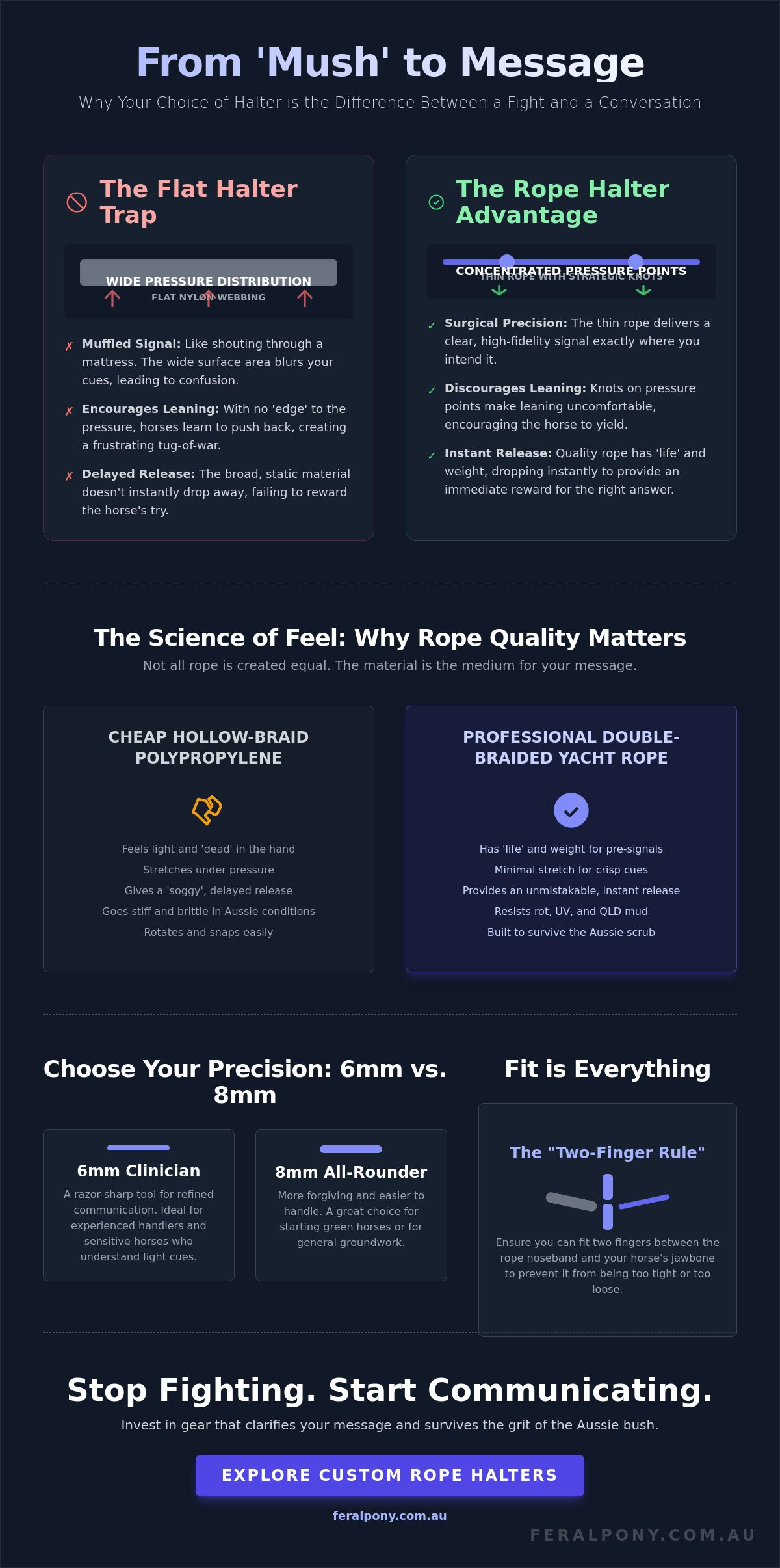
Flat nylon halters have their place. They are the pajamas of the horse world; comfortable, broad, and perfect for tying up at the float or grazing in the paddock. But when it comes to training, they are about as effective as shouting through a mattress. The wide webbing is designed to distribute pressure across a massive surface area. While that's great for comfort, it's a disaster for communication. When you use a flat halter, your signals become blurry. Your horse isn't necessarily being a pig; he just can't find the "edge" of your request through all that padding.
This lack of definition leads to one of the biggest headaches in horse handling: the leaner. Because the pressure is so diffused, horses naturally learn to push back against the strap. It's a physiological response. They get heavy in the hand, and suddenly you are in a tug-of-war you'll never win. A Rope horse halter is a completely different beast. It is a precision instrument designed for one thing: clear, high-fidelity communication. It isn't a "holding" tool. It's a training tool that delivers an immediate signal and, more importantly, an instant release the second the horse tries to find the right answer.
The Problem with "Mushy" Communication
Horses crave clarity. When your aids are mushy, frustration sets in on both ends of the lead. A horse that doesn't understand what's being asked will eventually start napping, pinning ears, or simply switching off. Flat halters encourage this because they don't offer a distinct "no." They just offer a dull, constant thud of pressure. You need gear that distinguishes between "staying" and "moving" without you having to haul on their head like a drongo. High-quality rope halters for groundwork stop the guessing game by making the right answer easy and the wrong answer uncomfortable.
Rope Halters: The Signal-to-Noise Ratio
It comes down to physics. A thinner rope provides a more concentrated signal. This doesn't mean you're being "meaner"; it means you can be lighter. You don't need brute force when the tool does the talking for you. The knots are strategically placed on pressure points to discourage the horse from leaning into the gear. If they push, they feel the knot. If they yield, the pressure vanishes instantly.
The secret is in the weight. A professional-grade halter has a specific "life" to it. The weighted loop under the chin acts as a pre-signal. When you move your hand, the horse feels the weight shift before they ever feel a pull. They learn to hunt for that subtle shift. This is how you transition from rope halters for groundwork to a horse that follows a feel, building a partnership based on precision rather than a fight.
The Science of Yacht Rope: Weight, Feel, and the Magic of the "Release"
If you think a rope is just a rope, you haven't felt the difference between a cheap hardware store knock-off and professional yachting rope. Most "bargain" halters are made from hollow-braid polypropylene. It’s light. It’s stiff. It feels dead in your hand. Worse, it stretches under pressure and stays stretched, meaning your "release" is about as crisp as a soggy biscuit. When you’re using rope halters for groundwork, the material isn't just about durability; it is the physical medium of your conversation with the horse.
High-grade double-braided polyester yacht rope is the gold standard for a reason. It has "life." This refers to the way the rope transmits energy from your hand to the horse's nose. When you relax your fingers, a quality halter "drops" instantly. That immediate weight change is the reward your horse is looking for. In the harsh Australian climate, this gear has to survive more than just a training session. Between the brutal QLD UV rays and the abrasive salt air, cheap ropes turn brittle and snap. Feral Pony uses yacht-grade rope that resists rot and won't go stiff as a board after being dragged through Darling Downs mud. If you want gear that actually works as hard as you do, check out the custom rope halters built for the real world.
Why Weight Matters More Than You Think
The "swing" of the rope is your pre-signal. Because yacht rope has a specific density, the horse can feel the air move and the rope shift before the halter even touches their skin. This gives them a split second to find the right answer before pressure is applied. A "dead" rope doesn't have this bounce. It just hangs there until you yank it. A weighted halter helps a horse find the release faster because the change in state-from tension to gravity-is unmistakable. It turns a clunky physical pull into a sophisticated signal.
The Anatomy of a Groundwork Halter
The knots aren't just there to hold the thing together. They are precision-placed pressure points. On the noseband, these knots sit over the sensitive areas of the face to discourage leaning. But the real engine room of the halter is the Fiador knot under the chin. This is the balance point. A perfectly balanced Fiador knot ensures the halter doesn’t twist into the horse’s eye when you apply lateral pressure. If this knot is tied poorly or sits off-centre, the whole halter shifts, creates a blurry signal, and risks rubbing the horse’s face. You want a tool that stays in place so your message stays clear.
- Double-braid polyester: Won't stretch or lose its shape over time.
- UV Resistance: Essential for gear that lives in the Aussie sun.
- Washable: Throw it in a bucket of soapy water after a muddy session and it comes out like new.
6mm vs 8mm: Selecting the Right Tool for Your Horse’s Temperament
Size matters. When you are picking out rope halters for groundwork, the diameter of the rope is your volume control. It dictates how loud your signal is and how much "bite" the horse feels when they hit the end of the lead. Most riders just grab whatever colour looks best on their chestnut. That is a rookie mistake. You need to match the tool to the horse's temperament and your own level of "feel." If you get this wrong, you are either whispering to a horse that's stone deaf or screaming at one that's already sensitive.
The physics are simple. A thinner rope concentrates pressure into a smaller area. A thicker rope spreads it out. Think of it like the difference between a scalpel and a sledgehammer. Both have their place in the shed, but you wouldn't use a sledgehammer for heart surgery. Whether you are starting a fresh colt or refining a finished show horse, the thickness of your gear will determine how quickly they find the release.
When to Choose a 6mm Rope Halter
The 6mm version, often called the "Clinician" style, is built for high-fidelity communication. It is thin, lightweight, and incredibly fast. This is the go-to for refined groundwork and liberty play where you want the horse to respond to the slightest flicker of your wrist. Because there is less surface area, the signal is "shorter" and sharper. Experienced handlers love them because they allow for extreme precision without needing to move their arms like they are swatting flies.
However, 6mm isn't for everyone. If you have a horse that is prone to panicking or is extremely reactive, this rope can be too "stinging" for them. It can cause a sensitive horse to overreact or "blow up" if the pressure is applied too abruptly. Use this diameter when your horse is already soft and you want to polish the fine details.
The Case for the 8mm All-Rounder
The 8mm halter is the workhorse of the Australian horse industry. It is more substantial, more forgiving, and handles the rough and tumble of station life without breaking a sweat. For green horses or those that have learned to pull and lean, the 8mm offers a clearer, more solid boundary. It doesn't "bite" as quickly as the 6mm, which gives a young horse a fraction more time to think before the pressure becomes uncomfortable.
This is also the best choice for beginners. If your timing isn't perfect yet, an 8mm halter won't punish the horse as severely for your mistakes. It provides a steady, reliable feel that builds confidence in both the horse and the handler. Plus, the thicker yacht rope is less likely to tangle or rub if you are working in the dust and sweat of a long afternoon in the yard. It is a durable, no-nonsense tool that gets the job done every time.
Whatever diameter you choose, remember to match your lead rope weight to the halter. Putting a heavy, thick lead on a 6mm halter is like putting tractor tyres on a Ferrari. It ruins the balance and muddies the signal. Keep your gear proportional to keep your message clear.
Groundwork Essentials: Using Your Rope Halter Without Being a Drongo
Safety first. Don't tie your horse up in a rope halter. Ever. It is a rookie mistake that can end in a trip to the vet or a wrecked fence. These rope halters for groundwork are made from unbreakable yacht rope. If your horse spooks and pulls back while tied to a solid post, the halter won't snap. Something else will. Usually, it is the horse's poll or your hitching rail. Use a flat nylon halter for the float and the wash bay. Use the rope halter for the work. It is a training tool, not a parking brake.
Getting the fit right is the difference between a clear signal and a blurry mess. You want the noseband sitting about two finger-widths below the cheekbone. Too high and it does nothing. Too low and you are pressing on the sensitive nasal cartilage. Once it's on, check the jaw. You should be able to fit two fingers comfortably under the rope. If it is too loose, the halter will twist into the horse's eye the moment you ask for lateral flexion. If it is too tight, the horse feels constant pressure. That is how you create a horse that stops listening.
The Correct Way to Tie a Rope Halter
How you tie the knot matters. If you do it wrong, and the horse pulls, the knot will jam so tight you'll need a knife to get it off. Follow this sequence every time. Pass the tail through the loop. Bring it around the back of the loop, towards the horse's tail. Then tuck it through the new loop you've created. The key is to tie the knot on the loop itself, not above it. Tying "above the loop" is a recipe for a jammed mess. Always ensure the tail is pointing away from the horse's eye to avoid irritation during your session.
Basic Groundwork Exercises to Try
The rope is just the messenger. Your timing is the real teacher. Start with the "Yield to Pressure" test. Apply a steady downward feel on the lead rope. The instant the horse drops its poll, even a millimetre, you must drop the rope. That release is the reward. You can also practice backing up with a simple wiggle of the lead. The weight of the yacht rope sends a vibration through the halter that tells the horse to move out of your space. Finally, work on lateral flexion. Ask the horse to bring its nose to its shoulder. It should be a soft, fluid motion. If they resist, hold steady. The moment they soften, give them the slack.
Ready to upgrade your communication? Grab one of our custom rope halters and start building a better connection in the yard today.
Feral Pony Custom Halters: Australian-Made Gear That Handles the Grit
We don't do fragile. Based in Geham, Queensland, Feral Pony was born out of a frustration with gear that couldn't handle the Darling Downs mud or the abrasive scrub of the Australian bush. Our rope halters for groundwork aren't mass-produced in a factory overseas. They are hand-tied right here by people who spend more time in the yard than in an office. This is gear for riders who embrace the mess. It is for those who value substance over superficial perfection and need a tool that works as hard as a station dog on a hot afternoon.
When you choose Feral Pony, you aren't just buying a halter. You are building a precision tool. We offer customisation because every horse is an individual. You choose the diameter, the nose padding, and the lead length. No more settling for "close enough" fits from a big-box saddlery. Our gear is designed to be tough, practical, and a little bit wild. It is a straight-talking solution for riders who are tired of blurry signals and gear that snaps when the pressure is on. We prioritise durability because we know that in the real world, "pretty" doesn't get the job done.
Custom Colours for Real Horse Life
The QLD sun is a killer. Most cheap rope fades to a dull grey within a month. We use high-grade, fade-resistant yacht rope that keeps its punch even after a summer of hard work. Whether you want a bold "Feral" aesthetic that stands out in the round yard or you need to organise your tack room with custom colour-coding for different horses, we have the options. It looks sharp. It stays sharp. More importantly, it doesn't rot or go mouldy when the humidity hits 90 percent. Our gear survives the elements so you can focus on the training.
Order Your Custom Groundwork Setup
A perfect fit is non-negotiable for clear communication. Measuring your horse is a simple process, and it ensures the knots sit exactly where they need to for maximum effectiveness. For the ultimate training kit, we recommend pairing your halter with a 12ft lead rope. This length gives you the distance needed for safe lunging and the weight required for those subtle pre-signals that make groundwork feel like a dance rather than a wrestling match. Stop fighting with inferior gear and start using tools that actually help your horse learn. Build your custom groundwork halter here and experience the difference that precision makes. It is time to get to work.
Stop Fighting and Start Communicating
Stop treating your horse's head like a handle. You have seen how the right diameter and the weight of high-grade yacht rope can transform a heavy, leaning horse into a responsive partner. It is all about the immediate release. The "life" in the rope tells the horse exactly when they have found the right answer, turning a messy struggle into a clear conversation. When you stop hauling and start signaling, the horse stops resisting and starts learning.
While communication in the yard is about moving away from conflict, for those who pursue the discipline of martial arts or combat sports, you can check out The Fight Club for high-quality, Australian-owned gear.
Our rope halters for groundwork are built for the grit of the real world. Every piece is hand-tied in Toowoomba, QLD, using high-grade, UV-stabilised yacht rope that won't rot or stretch when the weather turns. There is a reason professional clinicians across Australia trust our gear. It is tough, practical, and completely unapologetic about its quality. It survives the scrub and works harder than a station dog to keep your messages crisp.
Don't settle for "mushy" signals and cheap gear that fails when you need it most. It is time to upgrade your kit and your communication. Shop our rugged, custom-made Australian rope halters and get the clarity your horse deserves. Go out there and make it count.
Frequently Asked Questions
Is a rope halter too harsh for a sensitive horse?
A rope halter is only as harsh as the hands holding the lead rope. It is a precision tool designed for clear communication, not for punishment. For a sensitive horse, a rope halter is often a relief because the signal is clear and the release is instant. You don't have to nag them with dull, heavy pressure. Just be sure to use a light touch and reward the slightest try.
Can I tie my horse up in a rope halter?
Never tie your horse to a solid object using a rope halter. These tools are made from high-strength yacht rope that will not snap under pressure. If a horse panics and pulls back, something else has to give. That usually means a broken poll or a wrecked fence. Always swap to a flat nylon halter or use a breakaway lead if you need to tie up at the float.
What is the best rope diameter for a beginner in groundwork?
An 8mm diameter is the gold standard for beginners. It provides a more forgiving feel and a steadier boundary while you are still developing your timing. Thinner 6mm rope halters for groundwork are excellent for refined signals, but they can be too sharp if your hands are still a bit heavy. The 8mm version offers the perfect balance of durability and clear communication for everyday yard work.
How do I clean my rope halter after a muddy session?
Cleaning your gear is dead simple. Throw your halter in a bucket of warm, soapy water and give it a scrub with a stiff brush. For a deeper clean, pop it in a laundry bag and run it through the washing machine on a cold cycle. Always air dry your gear in the shade. Our UV-stabilised polyester rope won't go stiff or rot like cheap hardware store alternatives.
Why is my rope halter knot jamming?
A jammed knot is almost always a result of tying the tail above the loop rather than on it. When the horse pulls, a knot tied around the headstall rope will cinch down so tight you'll need a knife to get it off. Always pass the tail through the loop and tie the knot around the loop itself. This ensures the knot remains easy to undo, even after a heavy session.
How long should a groundwork lead rope be?
A 12ft (3.7m) lead rope is the sweet spot for groundwork. This length gives you enough room to stay out of the kick zone while lunging or sending your horse over obstacles. Shorter leads don't provide enough safety distance, and longer lines can become a tangled mess in the dirt. Pairing a 12ft weighted lead with your halter creates the ultimate kit for clear, long-distance communication.
Will a rope halter stretch over time?
Quality rope halters for groundwork made from double-braided polyester won't stretch a millimetre. This is why professional-grade gear is superior to cheap polypropylene versions found in big-box stores. Polypropylene has "memory" that causes it to elongate under load and stay stretched, which ruins the fit and muddies your signals. Our yacht rope is designed to maintain its shape and precision for years of hard use.
What is the difference between yacht rope and hardware store rope?
The difference lies in the "life" and durability of the material. Hardware store rope is usually hollow-braid polypropylene, which is light, stiff, and prone to rotting in the sun. Yacht rope is a high-density, double-braided polyester with a weighted core. It has a specific "bounce" that transmits your signals instantly. It feels alive in your hand, whereas cheap rope feels dead and unresponsive.