

What if everything you've been told about saddle sizing is just over-complicated fluff designed to sell you gear that doesn't actually work? Most riders treat fitting like a high school maths exam, but your horse doesn't care about a textbook number when you're deep in the scrub. You need to know how to measure for a western saddle without the headache of confusing US-centric charts or elitist jargon. It's about freedom for the horse and balance for you; nothing less.
We know the frustration of a saddle that slips the moment the terrain gets steep. It's even worse seeing your horse end a long day with a sore back because of a poor gullet fit. You want gear that stays put and stays comfortable. This no-nonsense guide is here to help you get the perfect fit for both horse and rider. We'll show you how to confidently choose the right gullet width and find a seat that won't leave you crippled after a full day of work.
Key Takeaways
- Move beyond generic bar sizes by identifying the three critical zones on your horse that actually dictate saddle stability.
- Master the "Fist Rule" to find a seat size that keeps you balanced without cramping your horse's movement.
- Get the lowdown on how to measure for a western saddle using a "naked" fit test to see what's really happening under the tree.
- Use the "Slide Test" to feel for uneven pressure points and ensure the bars are making full, even contact along the ribs.
- Learn why choosing gear built for Australian conditions is the only way to guarantee your saddle survives the long haul in the paddock.
Beyond the Tape Measure: Why Western Saddle Fit Matters in the Paddock
Most riders think fit is just a tape measure job. It isn't. If you are trying to figure out how to measure for a western saddle, you have to look past the leather. Fit is the fine balance between gullet clearance and bar contact. Get it wrong, and you're not just uncomfortable; you're dangerous. The Feral reality is simple. Gear that looks pretty in a showroom often bites when the work gets hard. Out in the scrub, a slipping saddle is a liability you can't afford.
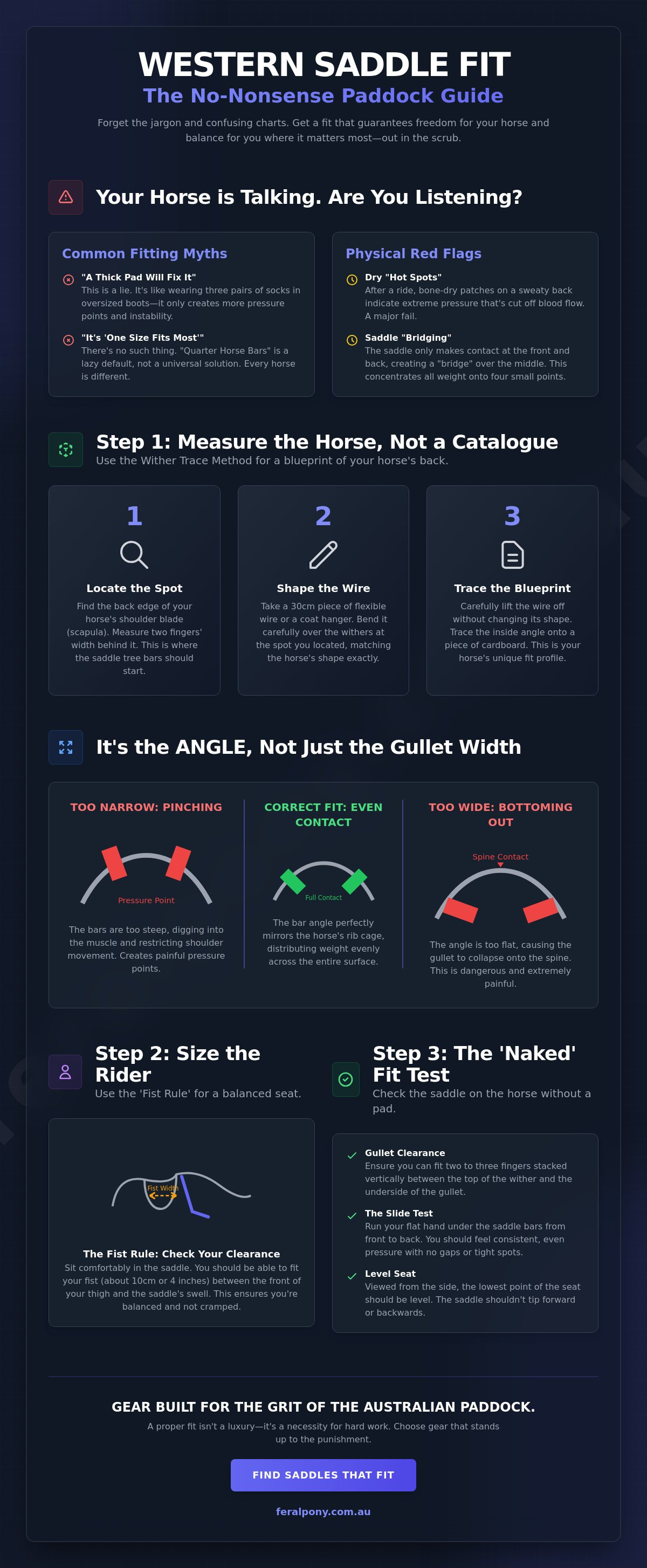
Don't fall for the "one size fits all" rubbish. It doesn't exist. Some blokes think a thick wool pad will fix a tree that's fundamentally wrong. That is a lie. It's like wearing three pairs of socks to make oversized boots fit; you're just creating more pressure. A bad fit leads to massive vet bills and a horse that eventually refuses to work. It's a betrayal of the animal carrying you. Do the work now, or pay for it later.
The Anatomy of a Good Fit
The tree is the skeleton of your ride. It consists of the bars, which run along the ribs, and the gullet, the tunnel that clears the spine. Unlike English gear, the design of the Western saddle is engineered to spread your weight over a massive surface area. But that only works if the "rock" and the "twist" match your horse. The rock is the curve from front to back. The twist is the angle of the bars as they follow the ribs. If the rock is too steep, the saddle will bridge, putting all your weight on four small points. That's a recipe for disaster.
Signs Your Current Saddle is Failing the Test
Your horse is already talking to you. You just need to listen. After a long ride, pull the saddle and check the sweat patterns. If the back is lathered but you see two bone-dry spots, you've found "hot spots." The pressure is so high it has pinched off the blood flow and sweat glands. That's a fail. Learning how to measure for a western saddle properly means spotting these red flags before they turn into white hairs or permanent scarring. If cinching up has become a wrestling match, your horse isn't being "feral" for the sake of it. He's bracing for the pain he knows is coming. Don't be the rider who ignores the warning signs until the damage is done.
Measuring Your Horse: Finding the Right Gullet and Bar Spread
Stop guessing. If you want to know how to measure for a western saddle, you start with the horse. Not a catalogue. Not what your mate told you at the pub. You need your horse standing square on level ground. If he is resting a leg or standing like a mountain goat on a slope, your measurements will be rubbish. Focus on three critical areas: the withers, the scapula, and the loin. This is where the weight sits and where the damage happens if you get it wrong.
The term "Quarter Horse Bars" is often used as a lazy industry default. It is a starting point, not a final answer. Every horse is built differently. A stocky Quarter Horse might actually need a wider bar angle than a high-withered Thoroughbred, even if the gullet width looks similar on paper. You aren't just looking for a width; you're looking for an angle that mirrors the ribcage. Getting this right is the difference between a horse that moves freely and one that's restricted and sour.
The Wither Trace Method
Forget high-tech scanners. You can do this with a piece of flexible wire about 30cm long. Find the back edge of the shoulder blade. Move two fingers behind that spot. This is where the front of the saddle tree will sit. Bend the wire over the withers so it hugs the shape of the horse perfectly. Lift it off carefully without bending it. Trace that shape onto a piece of cardboard or heavy paper. This trace is your blueprint. It shows the exact angle of the withers and helps you identify if you need a Semi-QH, Full-QH, or Draft bar spread. It’s a permanent record you can take to any saddlery.
Understanding Gullet Width vs. Angle
A common mistake is obsessing over gullet width while ignoring the bar angle. A 7-inch gullet might sound right, but if the bars are set at a steep angle, they will pinch the shoulders like a pair of pliers. Conversely, if the angle is too flat, the saddle will bottom out on the spine. Semi-QH bars are generally for narrower, more defined horses. Full-QH bars suit the wider, flatter-backed types often found in working lines. Draft bars are for the real heavy hitters. Don't measure too high up the wither; the bars sit lower than you think. Once you have your horse's profile sorted, you can look for rugged western saddles designed to handle the grit of the Australian paddock. Understanding how to measure for a western saddle means knowing exactly where that tree makes contact before you ever cinch up.
Sizing the Rider: How to Measure for Your Western Seat
Your jeans size is a lie. At least when it comes to leather. Thinking a size 34 waist translates directly to a specific saddle size is how you end up cramped or swimming in the seat. Rider fit is about more than just your backside. It is about balance and weight distribution. If you are sliding around, your horse is fighting to stay upright. When you are learning how to measure for a western saddle, you have to account for your own frame just as much as the horse’s anatomy. It is a partnership, not a solo act.
Stirrup length changes the game entirely. If you ride with a long, ranch-style leg, you need a different feel than someone tucked up for barrel racing. It is about where your centre of gravity sits. A seat that is too small pinches your thighs and shoves you against the cantle, causing you to lean forward and unbalance the horse. Too big? You are a passenger, not a pilot. You will be constantly bracing against the swells, which puts uneven pressure on the bars and sours your horse. Don't be the rider who buys a massive seat for "roominess" only to find they are rattling around like a stone in a tin can.
The Thigh Measurement Technique
Grab a sturdy chair. Sit flat with your feet on the floor and your knees at a 45-degree angle. Measure from the very back of your buttock, along the top of your thigh, to the end of your kneecap. This is the most accurate way to find your base size before you ever step foot in a shop. It ignores the vanity of clothing sizes and focuses on the actual bone structure of your leg.
- Under 50cm: You are usually looking at a 15-inch seat.
- 50cm to 55cm: This is standard 16-inch seat territory for most adult riders.
- Over 55cm: You will likely need a 17-inch seat or larger to avoid being pinned against the fork.
These numbers are your baseline. Remember that Western seat sizes are generally two inches smaller than English or stock saddle sizes. If you are switching from an English rig, don't let the smaller numbers bruise your ego. Trust the measurement.
The "Fist and Fingers" Real-World Check
Once you are actually in the seat, do the real-world clearance test. You should have about two fingers of space between the front of your thigh and the swell. Any tighter and you will lose skin during a quick stop or a sharp turn. At the back, you want about a hand’s width between your backside and the cantle. This gives you enough room to move with the horse without feeling disconnected from the tree. Understanding how to measure for a western saddle means checking these clearances while you are in your actual riding position, not just standing in the stirrups. If you can't fit your hand behind you, the saddle is too small. It is that simple.
The Real-World Fit Test: Checking the Saddle on Your Horse
You have done the traces. You have measured your thighs. Now comes the moment of truth. Put the saddle on your horse "naked." That means no pad, no cinch, and definitely no shims. Some companies will tell you to use shims to "fix" a dodgy fit. That is a lie. A shim is a band-aid, not a cure. If the tree doesn't work on its own, it isn't the right saddle. This is the most critical step in learning how to measure for a western saddle because it reveals exactly where the bars are biting or lifting.
Start with the "Slide Test." Run your flat hand under the front of the bars. It should feel like a firm, even handshake. If your fingers get pinched, the angle is too steep. If there is daylight, it’s too wide. Next, check for "bridging." This happens when the saddle touches at the front and back but leaves a gap in the middle. It’s a common fail in Western gear. Bridging concentrates all your weight onto two small areas, which will sore up a horse faster than a bad attitude. Your hand should feel consistent pressure all the way along the ribcage.
The ultimate truth teller is the sweat pattern. After a hard ride in the Queensland sun, pull your gear off and look. You want a solid, even dampness under the bars. Bone-dry spots in a sea of sweat are "hot spots" where the blood flow has been cut off. Conversely, a dry strip right down the spine is exactly what you want. It means the gullet did its job. If you are seeing uneven patches, it is time to re-evaluate your gear and look for high-quality western saddles that actually respect your horse’s conformation.
Gullet Clearance and Wither Room
Wither clearance is non-negotiable. You need the "Three Finger Rule." With the saddle sitting level, you should be able to fit three fingers vertically between the top of the withers and the bottom of the gullet. But don't stop there. Check the clearance all the way through the tunnel. The spine must never touch the tree. Have a mate look under the cantle while you are mounted. If the back of the saddle is bottoming out on the spine under your weight, the tree is too flat or the bars have too much "rock."
Shoulder Freedom and Movement
The #1 cause of Western saddle issues is positioning the gear too far forward. The front of the bars must sit behind the scapula (shoulder blade). If you pin the shoulder, your horse cannot extend properly. He will get choppy, sour, and eventually lame. Test the movement by having someone pick up a front leg and pull it forward while you feel the shoulder slide under the front of the bars. It should move freely without hitting a hard leather wall. Understanding how to measure for a western saddle is useless if you don't leave room for the horse to actually be a horse.
Choosing Your Gear: Why Feral Pony Saddles Stand Up to the Punishment
You have done the hard yards. You know exactly how to measure for a western saddle and you have spotted the red flags in your old gear. But all that data is useless if you try to squeeze it into a saddle that wasn't built for the Australian scrub. Most gear is designed for climate-controlled arenas and manicured trails. It fails the moment the humidity hits 90 percent or the dust starts grinding into the leather. You need equipment that respects the work you do.
Feral Pony gear bridges the gap between old-school craft and modern grit. We know every horse is a bit "feral" in their own way; no two backs are identical. That is why we offer custom options that actually account for the measurements you have taken. We use leather that handles the brutal cycle of Queensland sweat and sun without rotting or losing its shape. It is gear that stays supple where it needs to and rock-solid where it counts. No fluff. No excuses.
Toowoomba-Bred Quality
We are based in Toowoomba. Our gear is tested on the Darling Downs, not in a boardroom. We don't care about "pretty" stitching if it isn't going to hold up during a long day of mustering. We prioritise substance and durability over superficial perfection. When you choose our gear, you are supporting a brand that understands the messier, more demanding side of horse life. We build things to last because we know what happens when gear fails in the middle of nowhere. It isn't just an inconvenience; it's a safety issue.
Completing the Setup
A perfect tree fit is only half the battle. To keep that saddle stable, you need to match your measured rig with the right breastplate and girth. If your accessories are flimsy, your saddle will shift, and you will be right back where you started with a sore horse. Once you have mastered how to measure for a western saddle, don't let a cheap cinch ruin the result. A custom rope halter is the perfect partner for your new setup, giving you the control and durability that nylon just can't match. It's about building a complete system that works as hard as you do.
Check out our range of rugged Western gear here and get a setup that actually stands up to the punishment.
Get Your Rig Right and Hit the Scrub
Knowledge is only half the battle. You can spend all day learning how to measure for a western saddle, but if you try to shove those measurements into a flimsy, mass-produced tree, you're still going to end up with a sore horse. You've done the wither traces. You've checked the bar angles and ditched the vanity of your jeans size for a seat that actually balances your weight. Now you need gear that respects that effort and handles the reality of the Australian paddock.
Our saddles and accessories aren't designed for a showroom floor. They are tested in the brutal heat of the QLD bush and built with the durability required for a full day of work. We are a Toowoomba-based team that prioritises grit over glitz. We know what it's like to have gear fail when you're miles from the gate. Don't let a poor fit hold you back or sour your horse. Choose equipment that is as tough and authentic as the life you lead.
Shop Rugged Western Saddles and Gear
Trust your measurements and trust your horse. It is time to ride with the confidence that your gear is finally up to the task.
Frequently Asked Questions
What size Western saddle do I need for a 15hh Quarter Horse?
Tree size and seat size are two different beasts. A typical 15hh Quarter Horse usually requires Full Quarter Horse bars with a 7-inch gullet to accommodate a wider shoulder. For the rider, a 16-inch seat is the standard starting point for most adults. Don't buy based on the horse's height alone; it is the width and muscling of the back that dictates the tree size.
How do I know if the gullet on my Western saddle is too wide?
A saddle is too wide if the gullet sits lower than three fingers' width from the withers or if the entire rig tips forward. You will often see the back of the saddle lifting off the horse's loin when you cinch up. If the tree is resting directly on the spine, it is a disaster. Stop riding immediately and re-evaluate the bar angle.
Can I use a Western saddle on a horse with high withers?
You can, but you need a specific tree with a narrower gullet and more vertical clearance. Standard Western saddles often sit too low for high-withered types, leading to spinal pressure. Look for a Semi-QH bar spread. This provides the height needed so the gullet doesn't pinch the bone when the horse flexes and moves under your weight.
Is a 16-inch Western saddle the same as a 17-inch English saddle?
Not exactly. A 16-inch Western seat generally feels similar to a 17.5 or 18-inch English saddle. Western seats are measured from the back of the swell to the front of the cantle; English saddles measure from the pommel nail to the cantle centre. Always drop down about two inches in size when switching from English gear to a Western rig.
How much space should be between the wither and the gullet?
Aim for a clear three-finger gap between the top of the wither and the bottom of the gullet. This measurement must hold true even when the rider is fully mounted. If the gap disappears when you sit in the seat, the tree is too wide or the bars are too flat. Proper clearance ensures the horse can move without the tree grinding into its spine.
What happens if my Western saddle is too long for my horse’s back?
A saddle that is too long will dig into the horse's loin and kidneys, causing pain and restricted movement. This often leads to bucking or a horse that refuses to travel downhill. The bars of the saddle should never extend past the last rib. If the leather skirt is hitting the point of the hip, the saddle is too long for that horse.
How do I measure my horse for a Western saddle without a professional fitter?
You can learn how to measure for a western saddle using the wither trace method. Use a piece of flexible wire to map the shape of the horse's back exactly two fingers behind the shoulder blade. Transfer this shape to cardboard to create a template. This gives you a physical profile to compare against different trees without needing an expert on-site.
Does a thicker saddle pad help a saddle that is too wide?
No, a thicker pad is a band-aid for a bad tree. While it might temporarily lift the gullet off the withers, it won't fix an incorrect bar angle. It is like wearing three pairs of socks to make big boots fit; you just create new, uneven pressure points. If you want to know how to measure for a western saddle properly, you must prioritise the tree fit over the padding.