

Your stirrups aren't just footrests. They're the only thing standing between a solid day in the saddle and a week of limping around the yard. If you're still riding in flimsy irons that slip the moment things get dusty, you're asking for trouble. Finding the best western stirrups for 2026 is about more than just looking the part at a campdraft. It's about stability, survival, and stopping that deep, grinding ache in your knees before it starts.
We know the drill. You want gear that handles the mud, the heat, and the occasional knock against a gate post without shattering. You're tired of gear that looks good on a shelf but fails in the paddock. We agree that your equipment should work as hard as you do. This guide gives you the lowdown on choosing western stirrups that actually protect your joints and keep you balanced during long hours in the scrub.
We'll dive into the shift toward technical materials like aluminium, the importance of offset designs for rider comfort, and the latest safety trends you need to know before you cinch up. It's time to build a foundation that lasts a lifetime.
Key Takeaways
- Stop wasting cash on gear that snaps in the scrub. Learn which materials, from traditional wood to heavy-duty aluminium, actually handle the grit of the Australian outback.
- Save your knees and ankles from the dreaded stirrup twist. Discover how offset and slanted designs take the torque off your joints during those long days in the paddock.
- Find the best western stirrups for your specific riding style by weighing up the stability of a wide bell stirrup against the feel of a classic oxbow.
- Get the lowdown on how proper stirrup width and weight distribution act as your foundation for better balance and safety.
- Keep your kit in top shape with a no-nonsense maintenance routine that ensures your leathers and bolts never let you down when it matters most.
More Than a Footrest: Why Your Western Stirrups Matter
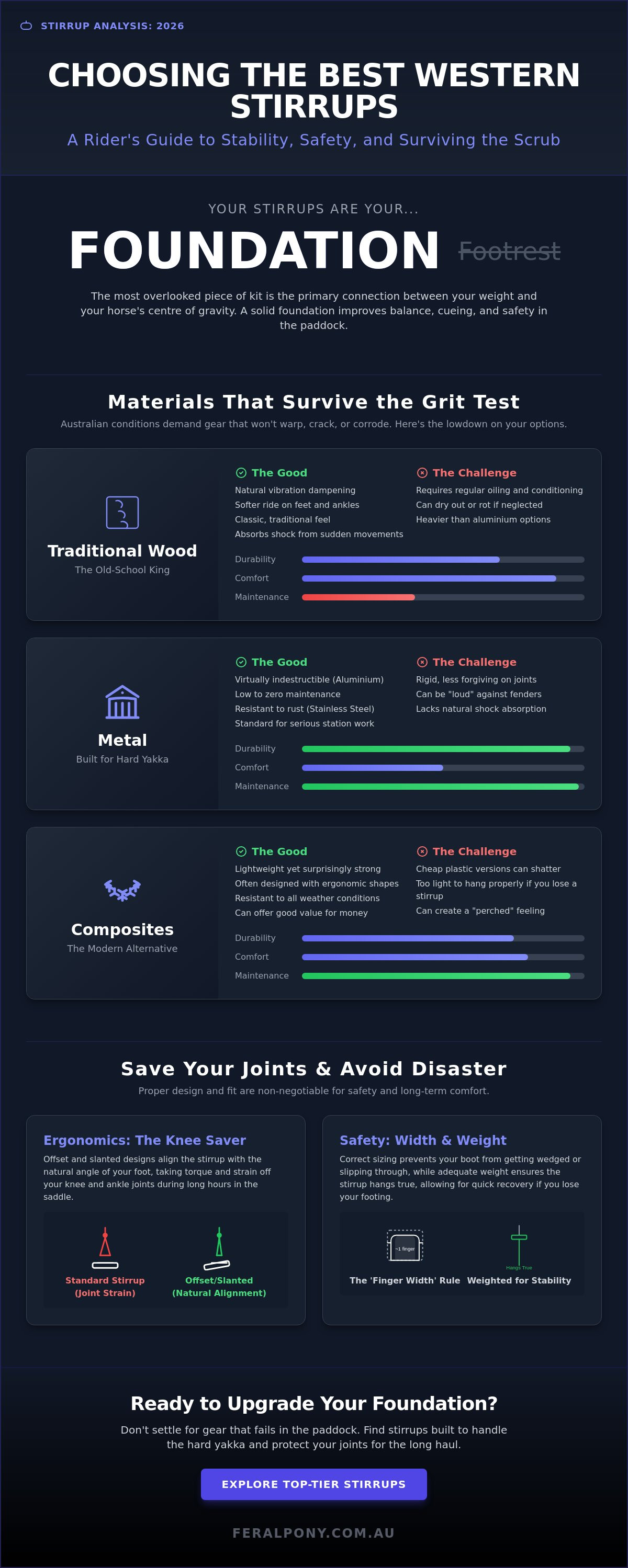
Your stirrups are the most underrated piece of kit in your tack room. Most riders spend thousands on a custom saddle then settle for whatever irons happened to be attached to the fenders. That is a massive mistake. You wouldn't build a homestead on a sandhill; don't ride on rubbish. Your stirrups are your foundation. They are the primary point where your weight meets the horse's centre of gravity. If that connection is flimsy, your balance is gone. Upgrading to the best western stirrups is the fastest, most cost-effective way to improve how your saddle performs in the paddock.
While the history of the stirrup shows they were originally designed for mounting and stability in battle, today they are about survival in the scrub. The wrong width or a lack of weight can turn a simple trip into a disaster. A quality stirrup provides the leverage you need to stay centred when a young horse gets leggy or the terrain gets vertical. It is about more than just a place to put your feet; it is about maintaining a secure, functional connection with your horse.
The Safety Factor: Avoiding the 'Hung Up' Nightmare
Width is a non-negotiable safety check. If your stirrup is too narrow, your boot gets wedged during a fall. If it is too wide, your whole foot can slide through the eye. Both scenarios lead to the "hung up" nightmare that every rider fears. You need roughly a finger's width of space on either side of your boot. Weight is just as vital for safety. A heavy stirrup stays put. If you lose your footing mid-ride, a weighted stirrup hangs straight and true. It doesn't flap around like a plastic bag in a gale. This allows you to find your seat again instantly without looking down or fishing with your toes.
Stability and the 'Deep Seat' Connection
Ever feel like you are perched on top of your horse rather than sitting in him? Cheap, lightweight plastic stirrups are usually the culprit. They are too light to pull your fenders down properly, which creates a "perched" riding position that kills your balance. Real stability comes from sinking your weight into your heels. A solid, weighted stirrup encourages a deep seat and better leg position. This makes your cueing clearer and your ride more secure. When you use the best western stirrups, you'll notice your leg stays quieter and your foundation remains rock solid, even after eight hours in the scrub.
Wood, Metal, or Plastic? Choosing Materials That Survive the Scrub
Australia doesn't do "gentle." Between the searing heat of the Pilbara and the bone-chilling damp of the Victorian High Country, your gear takes a beating every single day. The best western stirrups aren't just about matching your saddle's leather. They're about surviving the "Grit Test." If your gear fails when you're three hours from the home paddock, you're in for a long, miserable walk. You need materials that won't warp, crack, or corrode when the dust turns to mud and the temperature hits forty degrees.
The Case for Traditional Wood
Wood is the old-school king for a reason. Oak and ash provide a natural vibration dampening that metal simply can't match. It is a softer ride on your feet and ankles. However, wood requires a bit of respect. In high humidity, leather wraps can rot if you're lazy with the oil. You've got to keep them conditioned to prevent the grain from drying out. But for that classic feel and a foundation that absorbs the shock of a sudden bolt, wood remains a top-tier choice. It feels alive, unlike the cold rigidity of steel.
Metal Stirrups: Built for the Hard Yakka
If you want gear you can hose down and forget, metal is your best bet. Choosing the best western stirrups for station work usually leads riders straight to aluminium or galvanised steel. Aluminium oxbows are the standard for working riders because they're lightweight but virtually indestructible. For those riding near the salt air of the coast, stainless steel is the only way to avoid the rust that eats cheap gear alive. Just remember, metal is rigid. It doesn't flex. This can be "loud" against your fenders and less forgiving on your joints over long distances. Recent research on stirrup style suggests that how a stirrup handles biomechanical stress is crucial for long-term rider health. Metal is for the rider who prioritises sheer durability over dampening.
Composites: Not All Plastic is Created Equal
Don't confuse high-impact polymers with the toy plastic found on cheap import saddles. Quality composites are great for barrel racing or endurance where every gram counts. They're fast. They're light. But be warned. The Australian sun is a gear-killer. Cheap composites become brittle and snap under pressure after a few months of intense UV exposure. If you're going lightweight, ensure they're rated for high impact. If it feels like a lunchbox, don't put your life in it. If you're ready to upgrade to gear that actually survives the elements, take a look at our heavy-duty stirrups built for the real world.
Shape and Tread: Finding Your Foundation
Shape is the geometry of comfort. While we have already covered the materials that handle the grit, the actual profile of the iron determines where your weight settles. If you're on the hunt for the best western stirrups, you have to look past the shine. You need a shape that matches your job in the paddock. Whether you're cutting cattle or just trying to survive a long trek through the scrub, the footprint of your stirrup is your primary point of leverage. It is the difference between a secure leg and a foot that is constantly hunting for purchase.
The Bell Stirrup: Your Best Mate for Long Days
The bell stirrup is the heavy hitter for anyone spending eight hours in the seat. Its wide base is designed to spread the load across the ball of your foot. This prevents the "hot spots" that make you want to bail out of the saddle by midday. We reckon a 4-inch tread is the gold standard for paddock work. It provides a massive platform that stabilises your lower leg, making it one of the best western stirrups designs for general utility. Visalia and Roper styles offer similar benefits with slightly different profiles, but the goal remains the same: maximum surface area for minimum fatigue.
Oxbows: For the Traditionalist and the Trainer
Oxbows are narrow, curved, and built for the traditionalist. Unlike bells, these are meant to be ridden in the arch of the boot rather than on the ball of the foot. Trainers often favour them when starting colts because they offer a "locked-in" feel that is hard to beat when a horse starts acting up. You feel every twitch of the horse through the arch of your foot. Just be warned; because your weight is concentrated on a narrow strip, oxbows can be brutal on your knees during a 30-kilometre muster. They are built for the arena or short bursts of intense work, not for the long haul.
Tread Traction: Staying Put When Things Get Western
The tread is where your boot meets the iron. You have got options depending on how much "stick" you need to stay in the seat when things get western:
- Leather Treads: The classic choice. They wear in beautifully, providing a natural grip that doesn't feel restrictive or "stuck."
- Rubber and Foam Inserts: These add a layer of shock absorption that dampens the drone of the trail. Perfect for riders with old ankle injuries who need a bit of extra "cush."
- Metal Grips: Often called "cheesegraters," these are for when things get properly muddy. They ensure your foot isn't going anywhere. Just watch your fenders; they will chew through leather if you aren't careful.
Saving Your Knees: The Truth About Ergonomic and Offset Stirrups
Knee pain isn't a badge of honour. It is a sign of bad gear. If you're hobbling around the yard after a day in the scrub, your fenders are likely the culprit. Standard western fenders are thick, stubborn pieces of leather. They want to lay flat against the horse's ribs. When you shove your boot in, you're forcing that leather to twist ninety degrees. That tension doesn't just vanish. It travels straight up the stirrup, twists your ankle, and grinds into your knee. Finding the best western stirrups for your body means finding a way to kill that torque before it kills your joints.
You can test this easily. Stand in your stirrups and see if your weight is hitting the outside edge of your foot. If your pinky toe is going numb or your outer ankle feels like it's being pulled apart, you're fighting the "stirrup twist." While supple leather and a well-adjusted Blevins buckle help, they can't fix a fundamentally straight stirrup trying to work against a twisted fender. You need geometry on your side.
The Mechanics of the Slanted Stirrup
Slanted stirrups are built with an angled top bar. This design allows the stirrup to hang at a natural angle that matches the slope of your foot. You aren't fighting the heavy leather memory of the fender anymore. The stirrup stays where it should be, and your leg stays in a neutral, relaxed position. This is the best western stirrups choice for riders with old footy injuries or those who feel a sharp ache in their knees after an hour of trotting. It's about reducing the "fight" in your gear so you can focus on the ride.
Offset Stirrups: Centring Your Weight
Offset stirrups take a different approach to the same problem. By shifting the eye of the stirrup to one side, the design forces the tread to stay level even when your leg is angled. This prevents that nasty outside-edge pressure. It keeps your foot flat and your weight centred. A level foot means a more stable leg, which is vital when you're working a young horse in one of our custom rope halters australia. When your foundation is balanced, your cues are clearer. If you're ready to ditch the joint fatigue for good, check out our ergonomic stirrup collection designed for real-world Australian riding.
Don't ignore the warning signs from your body. A pair of offset or slanted stirrups is a small investment compared to the cost of a knee reconstruction. If your gear is making you miserable, it's time to change the gear, not the lifestyle.
Gear for the Long Haul: Maintenance and the Feral Pony Way
You've done the hard yards. You've researched the best western stirrups and bolted them onto your rig. Don't let that investment go to rot because you're too buggered to do a weekly check. In the scrub, gear failure isn't just an inconvenience. It is a safety hazard. If a piece of kit isn't tough enough to handle a season of dust, mud, and sweat, it has no business being in our kit. We prioritise substance over superficial perfection. We build things to last. But even the hardest gear needs a bit of respect to keep it performing at its peak when the pressure is on.
The "Feral" approach to gear is simple. We value honesty, utility, and resilience. We don't care about polished aesthetics that fail the moment they hit a gate post. We care about gear that survives the reality of Australian horse life. That means being proactive. It means knowing every inch of your tack. If you're lazy with your maintenance, you're inviting trouble into the paddock. A well-maintained stirrup is a reliable foundation. A neglected one is a liability.
Maintenance Tips for Gritty Gear
Leather-wrapped stirrups are the gold standard for grip, but they're a magnet for sweat and grit. If you let that muck sit, the salt will eat the leather and cause it to crack. Give them a wipe down after a heavy ride. If you're using aluminium irons, keep an eye out for metal fatigue. While quality aluminium is incredibly durable, years of heavy work and constant vibration can eventually take a toll. Don't wait for a snap to happen. Perform a "once-over" every time you cinch up. Check your bolts to ensure they haven't rattled loose on corrugated tracks. Inspect your leathers and Blevins buckles for any signs of fraying or thinning. Make sure your treads are still secure and haven't worn down to a slippery surface. This habit takes two minutes. It could save you a ten-kilometre walk home.
Stay Sharp, Stay Hydrated
The Aussie sun doesn't just bake your gear. It fries the rider. You can't make good decisions or stay balanced in the saddle if your brain is dehydrated. Rider resilience is just as important as the durability of your best western stirrups. We trust our rugged tumblers to keep our water ice-cold in the ute or the tack room, just like we trust our saddles to hold up in the scrub. Investing in quality means looking after the whole rig. That includes you. Keep your water cold, your gear clean, and your head in the game. If you look after your kit, it'll look after you when the terrain gets hairy. Grab a tumbler that’s as tough as your stirrups right here.
Build a Foundation That Lasts
Building a solid foundation in the saddle isn't about following trends. It is about gear that doesn't quit when the work gets heavy. You've seen how the right materials survive the scrub and why ergonomic shapes are the only way to save your joints from a lifetime of grinding. Choosing the best western stirrups is the first step toward a more stable, pain-free ride. It is about investing in quality that handles the grit of the Australian outback. This commitment to durability can extend to your personal care too; discover Reset Razor for eco-friendly, Australian-designed grooming tools built for the long haul.
We are Australian-owned and operated. Our gear is tested in real-world Queensland conditions to ensure it meets the demands of serious riders. No fluff. No nonsense. Just durability you can trust. Once your tack is sorted, don't forget the rider. Shop the Feral Pony Tumbler Collection for your next ride to stay as resilient as your equipment.
Get your kit sorted and get back out there. The paddock is waiting.
Common Questions from the Paddock
How do I know what size western stirrup I need for my boots?
You need roughly a finger's width of space on both sides of your boot at the widest point. If the fit is tighter than that, you risk getting hung up during a fall. If it is too wide, your whole foot can slide through the iron. Measure your widest work boots and add about an inch to find the best western stirrups width for your rig. Don't guess; a bad fit is a safety hazard.
Do slanted stirrups actually help with knee pain or is it just hype?
Slanted stirrups are the real deal for joint relief. They offset the natural twist of heavy leather fenders that usually forces your ankle into an awkward angle. This design allows your foot to sit flat without fighting the leather memory of the saddle. It isn't hype; it is basic biomechanics that stops the grinding ache in your knees. If you ride for hours, you will feel the difference.
What is the best material for western stirrups if I ride in mud and rain?
Aluminium or stainless steel are the undisputed kings of wet conditions. Unlike wood, these metals won't rot, warp, or swell when they are constantly soaked in the scrub. You can hose the mud off in seconds and they won't hold moisture against your leathers. Metal is the low-maintenance choice for riders who don't have the time or patience to pamper their gear after a storm.
Can I change the stirrups on my western saddle myself?
Changing your stirrups is a straightforward job you can handle in the tack room. Most modern saddles use a Blevins buckle or a simple bolt system on the fender. Just slide the fender down, unclip the buckle, swap the irons, and lock it back in. Always double-check the security of the buckle and the leather keeper before you swing up. It is a five-minute job that changes your entire ride.
Why are some western stirrups leather-wrapped and others aren't?
Leather wraps provide essential grip and act as a natural shock absorber. Raw metal can be slippery when wet and transmits every vibration from the horse's gait straight into your foot. The leather gives your boot something to bite into so your foot doesn't dance around. It also protects your fenders from being chewed up by the hard edges of the iron during long days in the seat.
Are lightweight composite stirrups safe for heavy ranch work?
Most cheap composites aren't built for the brutality of station life. While high-end polymers exist, the Australian sun makes cheap plastic brittle over time. If you are chasing cattle or riding in rough scrub, stick to aluminium or wood. You need a foundation that won't snap when a beast hits your leg or you knock a gate post. Don't trade your safety for a few saved grams.
How often should I check my stirrup leathers for wear and tear?
Give your leathers a quick squiz every single time you cinch up. Check for cracking around the holes and thinning where the leather meets the stirrup bar. A deep inspection should happen weekly if you are riding hard. Finding the best western stirrups won't matter if the leather holding them to the tree snaps mid-gallop. If it looks dodgy, replace it immediately. Don't risk a fall.
What is the difference between an oxbow and a bell stirrup?
It comes down to where you place your foot and how much support you want. Oxbows are narrow and designed to be ridden in the arch of the boot. Bell stirrups have a wide, flat tread for the ball of your foot. Bells are generally better for long days and joint comfort because they spread your weight. Oxbows are a traditional choice for trainers who want a locked-in feel when starting colts.